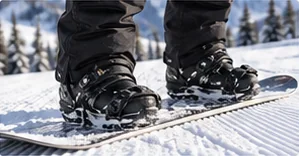
Breaking in and heat molding boots
Heat mold, break in and stop heel lift in snowboard boots.
Gear guide
Fit before looks
To size snowboard boots, measure your feet standing up in riding socks, find that length on the size chart for the exact model, then confirm the fit with the boot fully tightened and your knees bent. Snug everywhere, toes just brushing the front, heel staying down: that is the target.
At a glance
A real measurement beats guessing from your sneakers.
The quickest answer to how to size snowboard boots is: measure, then match the measurement to the chart for the boot you want. Burton’s boot sizing guide warns not to assume your snowboard boots will be the same size as your street shoes; sneaker size is only a starting point.
Burton recommends getting measured at a snowboard shop with a Brannock device (the metal foot-measuring tool you see in shoe stores) and trying several pairs. If you are measuring at home, we suggest this routine:
Note whether everyday shoes tend to feel narrow or roomy on you. That tells you whether to look for wide-fit models, which several brands offer.
Each brand, and sometimes each model, sizes differently.
Once you know your foot length, open the size chart for the exact boot you are considering. Charts use US men’s, US women’s, UK, EU or Mondopoint (a system based on foot length in centimeters), and the conversions are not identical from brand to brand. That is why “what size snowboard boots should I get?” has no single answer across the whole market.
Buying snowboard boots and bindings together? Your boot size decides which binding size you need, and very large boots on a narrow board can drag in turns. Compare your boot size with the board’s recommended range using our board sizing guide, and match bindings with our advice on binding sizes and compatibility. For growing feet, see sizing gear for kids.
Burton’s guide says to try boots on in the socks you will actually ride in, then stand up, walk around for 5–10 minutes and bend your knees to mimic your riding stance. A boot judged sitting down, half-laced, will fool you.
Buying snowboard boots online works best when you already know your size in that brand. Before you order, read the retailer’s returns policy, try the boots indoors on a clean floor, and keep the tags and box until you are sure.
Two checks tell you most of what you need to know.
How are snowboard boots supposed to fit compared to shoes? Tighter. A good boot feels snug all over, with firm, even contact and no sharp pressure.
Burton describes the target as toes that “just barely graze the front of the liner.” Standing tall they may touch; when you flex into your stance, your heel settles back and your toes should only brush the front.
With the boot fastened, lean forward over your toes. Your heel should stay on the footbed. Burton’s guide says that if your heel lifts while the boot is laced as tight as is comfortable, try a half size smaller. If the size is right and a little lift remains, our guide to heat molding, break-in and heel-lift fixes covers J-bars, heat molding and fitter tweaks.
| What you feel | What it usually means | What to try |
|---|---|---|
| Toes jammed or curled even with knees bent | Boots are too small | A half size larger (Burton’s suggestion) |
| Can’t feel the liner’s end at all standing tall | Boots may be too big | A half size smaller, then recheck heel hold |
| Heel lifts with the boot fully tightened | Too big or wrong heel shape | Smaller size or a different model |
| Pressure along the sides of the foot | Boot too narrow | A wider model rather than a longer size |
| Numb toes or pins and needles | Too tight or too small | Loosen the lower zone; if it persists, resize |
Some firmness is normal in new boots because liners pack down with use. Sharp pain or numbness is not.
Flex is how easily the boot bends forward and sideways. Burton’s guide pairs soft, forgiving boots with beginners and more responsive boots with all-mountain riders. There is no shared industry flex scale, so one brand’s “medium” can feel different from another’s; compare in person where you can.
Fit still comes first. A perfectly matched flex is no use in a boot that hurts.
Wondering how much to spend on snowboard boots? We suggest putting boots first in your gear budget, because a boot that fits affects every run. Prices change by season and store, so compare current listings rather than relying on a figure from a guide. Whatever you pay, tick these off:
If money is tight, our tips for riding without overspending cover renting and secondhand options.
Good habits keep a well-fitting boot fitting well. Pulling liners out and drying them after each day stops them breaking down early; see our routine for washing, drying and storing boots and liners. A snapped lace or a stuck dial is often fixable, and our page on fixing BOA dials, laces and soles explains the parts and warranty routes.
Consider new boots when:
In this series
Common questions
Snug all over without sharp pressure. With the boot fastened and your knees bent, your heel should stay down and your toes should just brush the front of the liner. Numbness or pins and needles mean something is too tight or the wrong size.
Not necessarily. Burton’s sizing guide says not to assume your snowboard boots will match your street shoes. Measure your feet and use the size chart for the exact model.
If you can’t feel the end of the liner standing tall, or your heel lifts when you lean forward with the boot tightened as much as is comfortable, the boot is probably too big. Burton suggests trying a half size smaller.
If your toes are jammed or curled even after you bend your knees into your stance, the boot is too small. Burton suggests trying a half size larger.
It is the most reliable way to buy your first pair. Staff can measure length and width, let you compare several models back to back and spot fit problems you might miss.
Related guides
Heat mold, break in and stop heel lift in snowboard boots.
Put on, tighten, loosen and take off laced, speed-lace and BOA boots.
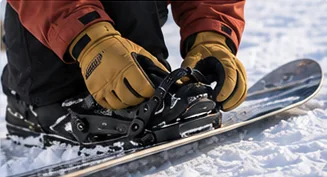
Match binding size to your boots, then check board fit and flex.