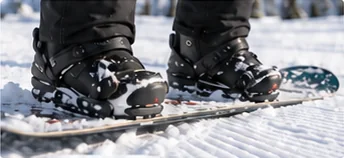
How to strap into a snowboard
Fasten and release your bindings safely and get a snug, secure fit.
Gear guide
Before your first day
To stand on a snowboard, you face sideways with one foot near the nose and one near the tail, knees soft and weight centered. The only real decision is which foot goes in front, and a few quick tests will tell you.
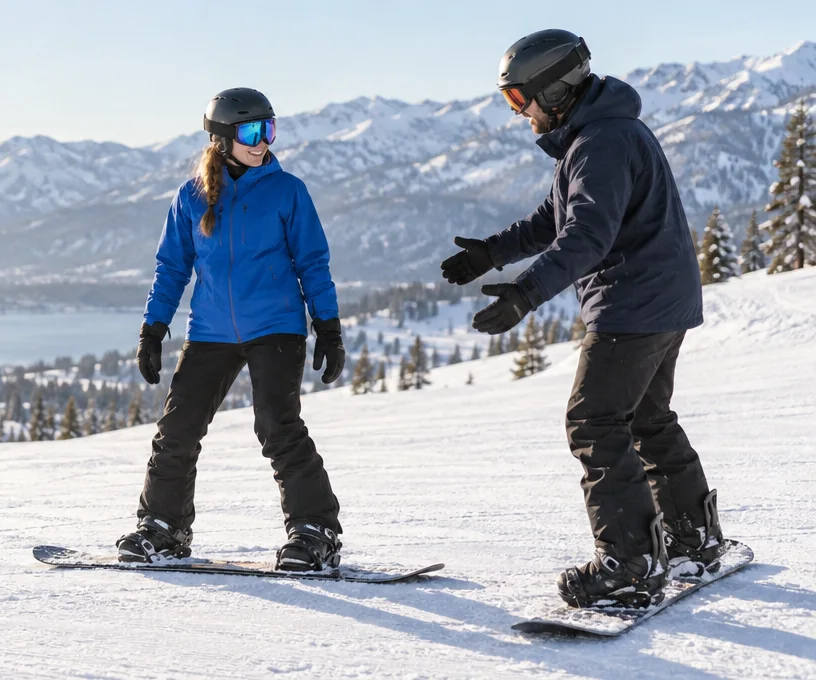
At a glance
Sideways, feet across the board, one foot leading.
Here is how to stand on a snowboard in one breath: turn sideways to the direction of travel, put one boot in each binding across the width of the board, flex your ankles and knees, and keep your weight over the middle. Your hips and shoulders line up roughly with the board, and your eyes look along it toward the nose.
That leaves one question every new rider has to answer: which foot goes at the front? That choice is your stance. It decides how your bindings are mounted, which end of the board leads, and which way you face on each edge. It is also the very first step in our beginner learning path, because everything from strapping in to your first turn assumes you know it.
The rest of this guide shows how to figure out your snowboard stance, how to tell the front of the board from the back, how to find a balanced posture and what to do if you later want to change direction.
Your stance is simply which foot leads when you ride.
Neither is better. Burton’s stance guide puts it plainly: regular does not mean correct and goofy does not mean incorrect. They are mirror images, and plenty of riders at every level ride goofy. The same guide notes that, generally, the back foot does more of the steering while the front foot helps with balance.
If you are renting, the shop will usually ask whether you are regular or goofy when they set up your board. If you are not sure yet, run through the tests below before you go.
Try a few and look for the answer that keeps coming up.
No single test is perfect, so try two or three and see which foot usually ends up in front. Do them somewhere safe with nothing to trip over.
Left foot forward in most tests means you probably ride regular; right foot forward means goofy. If the results are split, go with the one that felt most natural and mention it to your instructor or rental technician. Some people only discover on the snow that the other way feels better, and that is fine.
Once you know your leading foot, the bindings can be set up to match. Stance width and binding angles depend on the board, the bindings and your body, so they are covered separately in our guide to fine-tuning binding angles and width, and the full mounting process is in our binding setup walkthrough.
Know the nose from the tail before you mount or strap in.
The nose is the front of the board, the end that points where you are going. The tail is the back. Your front foot goes nearer the nose. How easy it is to tell them apart depends on the board’s shape:
| Board shape | How to tell nose from tail |
|---|---|
| Twin | Designed to ride the same both ways, so the ends can look almost identical. The “front” is simply whichever end your front foot points toward. |
| Directional or directional twin | Built to be ridden mostly one way. The nose and tail can differ in length, shape or flex, and the stance is often set back toward the tail. |
| Not sure | Check the logo and topsheet graphics, any markings near the inserts, and the product page or manual for your model, or ask the shop. |
A quick check on a board that is already set up: if the bindings sit a little closer to one end, that end is usually the tail. If you are still choosing a board, our guides on board shapes and types and picking the right length explain the differences.
A relaxed, athletic stance is the base for balance.
Knowing how to stand on a snowboard correctly matters as much as knowing which foot leads. A good starting posture looks like this:
Balance comes from small, relaxed movements in your ankles, knees and hips rather than from big arm swings. You can rehearse this posture on a carpet with the board unstrapped; our page on dryland drills before your trip has more ideas. Boots play a part too: if your heel lifts or your toes are cramped, read what a good boot fit feels like.
Changing stance direction means repositioning the bindings, not just turning around.
If your first session feels awkward and your instructor thinks the other stance might suit you, trying a swap is perfectly normal. How to switch snowboard bindings depends on whose board it is:
Riding with your opposite foot forward without moving the bindings is called riding switch. It is a later skill, useful for freestyle and all-mountain riding; when you are ready, see learning to ride the other way round. For now, pick one stance, get comfortable with it, and move on to getting your boots into the bindings.
Common questions
Try the slide, push and stairs tests. Burton’s stance guide says the foot that leads when you slide in socks is your front foot, and the foot that lands on the first stair is usually your back foot. Left foot forward is regular; right foot forward is goofy.
Neither. They are mirror images of each other. Ride the stance that feels most natural and balanced for you.
On a directional board the nose and tail usually differ in shape, length or flex, and the bindings are often set back toward the tail. On a twin the ends can look the same, so the front is whichever end your front foot points toward. If in doubt, check the manufacturer’s product page or ask the shop.
Flex your ankles and knees, keep your weight centered between your feet, stand tall through your upper body and look ahead instead of at your feet. Small movements in your legs do the balancing.
Yes. The bindings are repositioned so your new front foot is nearer the nose and the angles are adjusted for the new direction. A rental shop will do it for you; on your own board, follow the binding manual or ask a shop.
Related guides
Fasten and release your bindings safely and get a snug, secure fit.
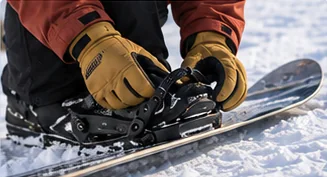
Fine-tune angles, stance width, straps and forward lean.
Choose the right board length and width for your weight, boots and riding style.