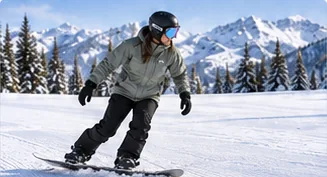
How to ollie on a snowboard
Use the tail of your board to pop off the snow in control.
Next-level skills
Presses and board feel
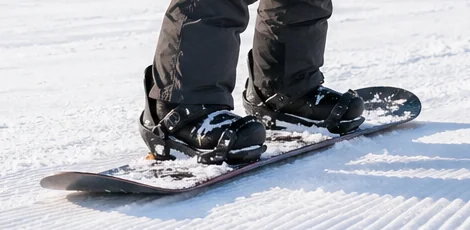
To butter on a snowboard, ride slowly on a gentle slope, shift your hips over the nose or tail until the other end lifts, then hold the press or let your shoulders pivot the board around. Start with straight presses, then add pivots, nose rolls and tripods.
At a glance
Before this guide
Butters are ground tricks, so a quiet groomed run is all the terrain you need.
How to butter a snowboard, in short: move your weight over one end of the board so the other end lifts and the board flexes, then either hold that press or pivot around it. Butters are all about controlling how the board bends and turns while it stays partly on the snow.
That matches how PSIA-AASI’s Freestyle Specialist Performance Guide describes a good butter for instructors: a sustained pivot and press with the board in partial contact with the snow, the rider’s center of mass over the nose or tail, performed both clockwise and counterclockwise. Its entry-level snowboard list includes butters out to 90 degrees and back to a forward stance, 180 nose or tail butters, and 360 butters.
You don’t need a terrain park. A gentle, wide, quiet groomed run is ideal: practice at the side, where you’re visible from above and out of the main traffic line. Because many butters finish with the board pointing the other way, some switch riding helps.
A fitted, buckled helmet is worth wearing even on flat terrain: catching an edge while pressing can cause a quick fall, often backward.
Presses are the building block of every butter.
Start on flat ground, strapped in, then move to a gentle slope, running straight and slow.
Keep the board flat across its width. If one edge digs in mid-press it can catch, so stay balanced over the middle of the board from edge to edge. The same flat, centered press is what you’ll use later on low boxes in the park.
Small, smooth weight shifts beat big lunges.
Most butter falls come from moving too far, too quickly. These drills build control:
Your arms help with balance, but avoid swinging them wildly. Let your shoulders lead gently in the direction you want the board to pivot. The same press-and-pop feeling helps your ollies, which also start by loading the tail.
Put presses and pivots together into your first real butter tricks.
Riding slowly, press onto the nose, then use your shoulders and hips to let the tail swing around until the board points the other way. Settle flat and ride away switch. Many riders call a full pivot on the nose a nose roll. Try both directions; one will feel easier.
Riding switch, press onto your tail (now the leading end), pivot around and ride away in your normal stance.
A tripod is a stationary or very slow trick where you press the nose or tail and support yourself with one or both hands on the snow. Learn it on flat ground first, keep your wrists relaxed and only lean onto your hands as far as you can control.
A full rotation on the snow is two 180 butters joined together.
Once 180 butters feel easy in both directions, a butter 360 joins a nose pivot and a tail pivot into one continuous rotation: press the nose and pivot to switch, then shift to the tail and keep turning until you face forward again. Keep the speed very low and the board flat across its width all the way around.
This on-snow rotation is also good preparation for rotating in the air. It gives you the feel of turning your upper body first with the board following, which you’ll use for ollie 180s on the flat and later for full spins off small jumps. A qualified freestyle coach can check your balance and edge control before you add speed.
We suggest adding a few butters to each easy run rather than spending a whole day on them. To see where buttering sits among the other freestyle skills, look at our map of the trick learning order.
You can butter on any board; a stiffer one just asks for more precise weight shifts.
Softer, more flexible boards are generally easier to press. On a stiffer board, keep the movements small, move your hips further over the nose or tail, and use your body weight rather than trying to muscle the board around. Lower speed helps too. If you want to know how flexible your board is, check the manufacturer’s description for your model.
Most butter slams come from a tipped edge or too much speed.
Practice goals
Checking a box records your practice. Ask your instructor when you are ready to progress.
Common questions
A butter is a ground trick where you press onto the nose or tail so the board flexes, often pivoting or spinning on the snow while you slide slowly.
Ride slowly and straight, move your hips and chest toward your front foot so the tail lifts, then let your shoulders guide the tail around. Keep the board flat across its width so the edges don’t catch.
Learn it on flat ground: press the nose or tail and support yourself with one or both hands on the snow. Only lean onto your hands as far as you can control, and build up slowly.
Get 180 butters solid in both directions first. Then join a nose pivot and a tail pivot into one continuous rotation at very low speed, keeping the board flat across its width all the way around.
A manual is another name for a tail press: you shift your weight over the tail so the nose lifts, and hold it while you slide. A nose manual, or nose press, does the same on the front of the board.
Up next
Use the tail of your board to pop off the snow in control.
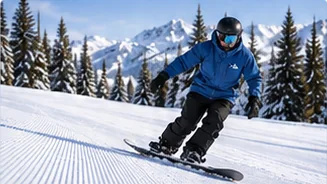
Rotate half a turn and land riding switch, starting on the snow.
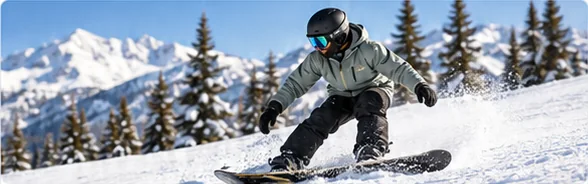
Start with 50-50s on low, wide boxes before any boardslides.