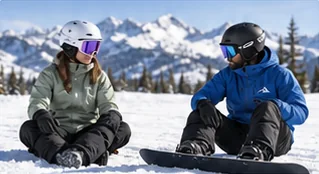
Helping kids learn to snowboard
Help children learn with gear that fits, short sessions and lessons.
Gear guide
Use the model’s kids’ chart
To size a snowboard for kids, weigh your child, get their snowboard boots fitted, then find the length on the size chart for the specific kids’ model whose weight range includes them. There is no single formula that works across every board.
Part of Choosing a snowboard
At a glance
Each kids’ model has its own chart. Start there, not with a rule of thumb.
The most reliable way to size a snowboard for kids is to look up the manufacturer’s chart for the exact kids’ or youth model you are considering. Kids’ boards are built differently from adult boards, with their own lengths, widths and flex, and each model’s chart links a length to a recommended rider weight range.
Avoid length formulas based on height or age. They ignore how a particular board is built, and they differ from one source to the next. Burton’s parent’s guide to kids’ snowboards says that height can give a ballpark, but recommends sticking with weight and boot size.
The process is the same for boys’ and girls’ boards and for youth models: some brands make separate girls’ or youth ranges with their own charts, so use the chart that belongs to the board. For a general explanation of how size charts work, see our adult sizing walkthrough.
You need two measurements: weight and boot size. Weigh your child in the clothes they usually ride in, and use the same unit as the chart. If they sit between two lengths, the model’s description or a shop can help you decide, usually with their ability in mind.
Boots matter more than almost anything else for a young rider. Boots that are too big make it hard to control the board, and boots that hurt end the day early. Have your child’s feet measured, ideally in a shop, then check the brand’s kids’ boot chart and try the boots on with the socks they will ride in. Fit them to your child’s feet now rather than buying several sizes up. Our boot fit checks explain what a good fit feels like.
Some kids’ boots are designed to allow for growth. Burton’s kids’ guide, for example, says boots with its Room-To-Grow footbeds can accommodate larger feet, “up to one full size larger by removing the primary footbed.” Features like this vary by brand and model, so check the product description.
Then check the board’s width. Once the bindings are set up, the boots should not hang so far over the edges that the toes or heels drag in the snow during turns. Burton makes the same point in its kids’ guide.
Kids’ bindings come in their own size ranges. Burton’s size charts list separate kids’ binding sizes by boot size. Check that the child’s boots fall within the binding’s range. See our binding sizing guide.
For beginners, stay within the manufacturer’s recommendation.
If your child has never snowboarded before, stick to the length the model’s chart recommends for their weight. Burton’s guide gives the same advice, and suggests that only riders who are already confident might go a little longer for stability at speed, or a little shorter for easier turning.
Flex matters too. Kids’ beginner boards are usually soft, which makes them easier to turn at low speed. Stiffer boards suit stronger, more experienced young riders. If a board feels too stiff or too long, a beginner will find it hard to turn and stop, and that can make learning frustrating.
The best way to learn is with a qualified instructor in a lesson designed for children. See teaching kids to snowboard and finding snowboard lessons.
Children grow quickly, so it is worth thinking about how often your child will ride before you buy.
Check the fit at the start of every season.
It is tempting to buy a board to grow into. For beginners, that usually makes learning harder, because a board that is too long for their weight is harder to turn and control. Burton’s guide notes that only experienced young riders who can handle it should size up, and that kids’ feet grow quickly, so allow for changes over the next season or two when choosing boots and bindings.
Before each season, and after a growth spurt, check:
When the board no longer fits, pass it on to a younger rider, sell it or donate it. Our guide to reusing and recycling snowboard equipment has ideas.
Common questions
Use the size chart for the specific kids’ board you are considering. Find the length where your child’s weight fits the recommended range, then check that the board is wide enough for their boots. Beginners should stay within the manufacturer’s recommendation.
Height can give a rough idea, but manufacturers such as Burton recommend using weight and boot size. Always use the chart for the model rather than a general height formula.
Not for a beginner. A board that is too long for their weight is harder to turn and stop. Only experienced young riders who can handle it should consider sizing up.
Weigh them in the clothes they usually wear and have their feet measured for snowboard boots. Use those numbers with the board’s own size chart and the brand’s kids’ boot and binding charts.
Snug, with their heel held down and no painful pressure, in the socks they ride in. Fit them to your child’s feet now rather than buying several sizes up; some brands make kids’ boots with removable footbeds that allow a little growth.
Renting suits first trips and children who ride a few days a season. Buying new or used makes more sense for children who ride often. Check the fit again every season as they grow.
Related guides
Help children learn with gear that fits, short sessions and lessons.
Choose the right board length and width for your weight, boots and riding style.
Measure, size and fit-check snowboard boots before you buy.