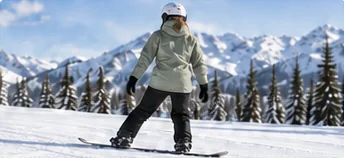
How to ride switch on a snowboard
Learn to ride and turn with your opposite foot forward.
Next-level skills
First rotation
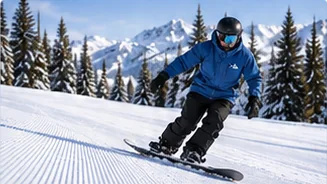
To do a 180 on a snowboard, set your speed, pop an ollie, then let your head and shoulders turn the board half a rotation and land riding switch. Learn it as a ground 180 first, then as a small ollie 180 on a groomed run, and only then on a small jump with a coach.
At a glance
Before this guide
A 180 combines switch riding, pop and rotation, so each part needs to be solid.
How to do a 180 on a snowboard, in short: ride straight, set your speed, pop, turn half a rotation in the air and land riding the other way. Because every 180 finishes in switch, shaky switch riding means a shaky landing. Get comfortable linking switch turns on easy runs first.
PSIA-AASI’s Freestyle Specialist Performance Guide, which sets the standard for freestyle instructors, puts it in three words: “set speed, then pop and spin.” It asks entry-level instructors to show a variety of air 180s outside the park on a groomed slope before spinning 180s off small jumps. That order is a good one for learners too.
You also need a reliable tail pop, and for 180s off park jumps you should already land straight airs on the smallest features comfortably. Buckle a well-fitted helmet before you start; rotations add new ways to fall, including catching an edge on landing.
The names describe which side of your body leads the spin.
| Frontside 180 | Backside 180 | |
|---|---|---|
| What leads | Your chest turns toward the direction of travel | Your back turns toward the direction of travel |
| Edge many coaches suggest spinning from | Often a light heel edge | Often a light toe edge |
| How it feels | Some riders find it easier to keep an eye on the landing | Some riders find it a more natural wind-up |
Which way is clockwise depends on whether you ride regular or goofy, and whether you start in your normal stance or switch. That’s why riders describe spins as frontside or backside rather than left or right.
Riders differ on which is easier for a first 180. Try both on the snow and ask a coach which to focus on. PSIA-AASI’s entry-level list includes both frontside and backside 180s, so plan to learn both in the long run.
Build the rotation with the board on the snow first.
On a gentle, quiet groomed slope at low speed, turn the board 180 degrees while it stays on the snow, then ride away switch. A light press on the nose or tail helps it pivot, just like the 180 butters in our buttering guide. Keep the base flat as the board comes around so the edges don’t catch.
Practice both directions until you can finish each one riding away cleanly in switch.
Add a small pop and turn the board half a rotation in the air.
Keep the rotation smooth. Throwing your arms hard usually over-rotates or drops you onto an edge.
Same movements, less margin for error, so bring a coach.
Only move to a small park jump once ground 180s and ollie 180s are routine and a qualified coach agrees. The movements are the same, but timing on a take-off is different and mistakes cost more. Keep your approach speed exactly where it is for your straight airs on that jump. A faster run-in won’t make the rotation easier, and it pushes you further down the landing.
A park-specific lesson is part of NSAA’s advice for anyone new to freestyle terrain. In US schools, instructors who teach in the park may hold a PSIA-AASI Freestyle Specialist certificate; our guide to finding a freestyle lesson explains what to ask for. Before each attempt, decide which way you’ll spin, check nobody is in the landing, and pick a jump you already clear comfortably.
Land flat, centered and pointing straight, then ride away in your new direction.
Landing short of the full 180 and skidding around is common early on. Go back to the ground and flat versions until the rotation is complete in the air.
Spinning off a feature is a later step, not a first 180.
Spinning on or off a box shows up only in PSIA-AASI’s FS 2 trick list, a level above straight slides, boardslides and 180s on small jumps. Get comfortable with 50-50s and clean exits on low ride-on boxes first, and learn box spins in person with a park coach.
When 180s are consistent in both directions, the next rotation is the full 360. To see where spins sit among the other freestyle skills, read our step-by-step freestyle learning order.
Most incomplete 180s trace back to timing or a stiff upper body.
Practice goals
Checking a box records your practice. Ask your instructor when you are ready to progress.
Common questions
Start with ground 180s on an easy slope, then small ollie 180s on a groomed run. Set your speed, pop, then let your head and shoulders lead a half rotation, spot the landing and land flat and centered, riding away switch.
On a frontside 180, your chest turns toward the direction of travel as you rotate. On a backside 180, your back turns toward it first.
Build it on the snow with ground 180s in the backside direction, then add a small ollie on easy groomed terrain. Only take it to a small park jump when it’s consistent and a qualified coach agrees.
Follow the same steps in the frontside direction: ground 180s, then ollie 180s on a groomed run, then a small jump with a coach. Keep your head turning toward the landing so the rotation finishes.
Yes, but it comes later than your first jump 180s. Get 50-50s, clean exits and flat-ground 180s solid first, and learn it with a park coach.
Up next
Learn to ride and turn with your opposite foot forward.
How park jumps work and how to start small with coaching.
A full rotation built on solid 180s, jumps and coaching.