
Progressing to steeper terrain
Step up to steeper runs gradually, with speed control on every turn.
Next-level skills
Bumps and rhythm
To snowboard moguls, start on small, widely spaced bumps, turn on the top or shoulder of each one where the board pivots easily, and let your legs bend and extend like suspension while short skidded turns keep your speed down.
Part of Carving and all-mountain riding
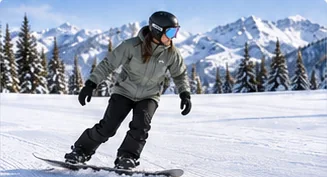
At a glance
Before this guide
Moguls magnify small weaknesses, so make sure your basics are solid.
Learning how to snowboard moguls is mostly about controlling speed in terrain that keeps changing under your feet. Moguls are the bumps that form when many riders and skiers turn in the same places, pushing snow into mounds with troughs between them.
Before you head down a mogul run, you should be able to:
Good edge control from carving practice on smooth groomers helps, but bumps call for a different blend: shorter, more skidded turns and much more leg movement. Mogul runs are often marked as more difficult because of their bumps, even if the slope underneath is not especially steep. Start on the smallest, most widely spaced bumps you can find, often at the side of a groomed run late in the day. An instructor can point you to suitable terrain and give you drills that fit your riding.
Look ahead, plan several turns at a time and choose a route that suits your speed.
Staring at the bump in front of you is a recipe for getting stuck. Instead, stop at the side where you are visible from above, look down the run and plan a route.
There is no single correct line. As you improve, you will learn to ride different routes through the same field. Start with the one that lets you stay in control.
Let your legs work like suspension so the board stays in contact with the snow.
Riding bumpy terrain well means keeping your upper body fairly quiet while your legs bend and extend beneath you.
Think of your legs as shock absorbers and your head as staying at roughly the same height. Practice the flex-and-extend movement on rolling groomed terrain first, where you can concentrate on the movement without worrying about the next bump.
Scrub a little speed on every turn so it never builds up.
Speed is the main challenge when you go down moguls on a snowboard. Each bump can launch you if you arrive too fast, and the troughs between them funnel you downhill.
The NSAA’s Your Responsibility Code says you must be able to stop or avoid people or objects. If you cannot do that in the bumps, move to smaller moguls or a groomed run.
Harder bump runs stack several challenges at once.
Steep moguls combine two difficult things: bumps and pitch. Build up to them only after smaller bumps feel routine and you have spent time riding steeper groomed terrain in control. On steep bumps, sideslipping the first few moguls to find your rhythm is a sensible way in.
Icy moguls are much harder than soft ones, because the edge has little to grip on the back side of each bump. Our tips for handling hard-packed and icy snow apply, and waiting for the snow to soften later in the day is often the better plan. In spring, bumps that are firm in the morning can become soft and forgiving by midday.
A lesson focused on bumps is one of the quickest ways to make progress, because an instructor can see exactly where your turns lose control.
Practice goals
Checking a box records your practice. Ask your instructor when you are ready to progress.
Common questions
Many riders start by turning on the top or shoulder of a bump, where the nose and tail of the board are off the snow and it is easier to pivot. Then use the back side of the bump to control speed.
Keep your legs flexed and let them absorb each bump: bend your knees as you ride up the mogul and extend them as you go down the other side, keeping your upper body quiet.
Use short, skidded turns and finish each one across the hill before the next bump. If speed builds, sideslip or traverse to the side of the run to reset.
Get comfortable on smaller bumps and on steep groomed runs separately first. On steep bumps, sideslip the first few moguls to find a rhythm, keep turns short and stop at the side whenever speed builds.
It depends on the rider, but moguls challenge many snowboarders because the board is long and both feet are fixed. Short turns, flexed legs and good line choice make a big difference.
Up next
Step up to steeper runs gradually, with speed control on every turn.
Stay in control on hard-packed and icy snow with better edge use.
Turn on each edge, change edges and link your first S-turns.