How to choose a snowboard
Match board type, profile and flex to your ability and terrain.
Gear guide
Different boards for different days
To build a snowboard quiver, start with one board that covers most of your days, then add a second only when it does a job the first can’t, such as deep powder or park laps. Each board should earn its place.
Part of Choosing a snowboard
At a glance
List the days you actually ride, not the days you imagine.
A snowboard quiver is simply the set of boards you own, and the first step in building one is being honest about your season. Think back over your last few trips, or plan the next ones, and note:
If most of your days are on groomed runs with some park laps, that tells you something different from a rider who chases fresh snow. Your quiver should reflect the pattern, not the exceptions.
It also helps to note what frustrates you on your current board. Perhaps the nose sinks in deep snow, the board feels nervous at speed, or it is hard work to press on park features. Those notes become your shopping list, and they are far more useful than a board’s marketing description when you compare options later.
Most riders should start with one board that handles most of their riding well. For many people that is an all-mountain board, which is designed to cope with groomed runs, some park and some soft snow. Burton’s snowboard buying guide describes all-mountain boards in exactly this way.
Choose this board with the same care as any first board: match its type, profile and flex to your ability and terrain, then check its size and width on the manufacturer’s chart. Our board-choosing walkthrough and size chart guide cover those steps.
Many riders are happy with one board for years. A second board is worth thinking about only when you notice the same gap again and again: the board feels hard work in deep snow, too stiff for the park, or unstable at speed.
Choose a second board that does something your first one does not.
A good second board fills the gap you identified. Here is how quivers commonly grow, as examples rather than a formula:
| Quiver size | Typical makeup | Who it suits |
|---|---|---|
| One board | An all-mountain board | Most riders, especially in their first seasons |
| Two boards | All-mountain plus a specialist (powder, park or carving) | Riders who keep hitting the same limit |
| Three or more | Separate boards for powder, park and hard-snow carving, or a splitboard | Frequent riders with varied conditions and space to store them |
Some common two-board pairings:
Size each board on its own chart. Specialist shapes, such as some powder boards, may be sized differently from your everyday board, so do not assume the same length carries across.
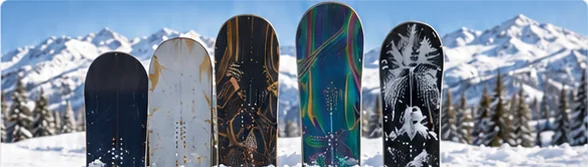
The most common quiver mistake is buying a second board that is almost the same as the first. Before you buy, compare the two side by side:
If the answers are mostly the same, the new board will not change your riding much. Ask yourself which days you would pick the new board over the old one. If you cannot name them, you probably do not need it yet.
You can move one pair of bindings between boards if they are compatible with each board’s mounting system, but that means remounting and rechecking them each time. Some riders keep a pair of bindings on each board. Either way, follow our binding mounting steps and your manuals whenever you swap, and check each board’s mounting pattern first.
A second board is a bigger commitment than it looks, so test the idea before you pay for it:
Every extra board needs money, space and maintenance. Consider these before you add one:
When a board no longer earns its place, pass it on rather than letting it sit unused. Our guide to reusing and recycling snowboard equipment explains how.
Common questions
A snowboard quiver is the set of boards a rider owns, with each board suited to different conditions or styles of riding, such as groomed runs, park or powder.
Not necessarily. Many riders use one all-mountain board for most of their riding. Consider a second board only when you keep finding the same gap, such as struggling in deep snow or wanting a softer board for the park.
One that does something your first board does not. Common choices are a powder board alongside an all-mountain board, or a softer park board alongside a stiffer board for carving.
There is no right number. Most riders do well with one all-mountain board, and many add a second only for a specific job such as powder or park. Add boards when you can name the days you would ride them.
Yes, if the bindings are compatible with each board’s mounting system. You will need to remount and recheck them each time you swap, following your binding manual.
Related guides
Match board type, profile and flex to your ability and terrain.
Choose the right board length and width for your weight, boots and riding style.
Check a second-hand board’s model, condition and fit before buying.