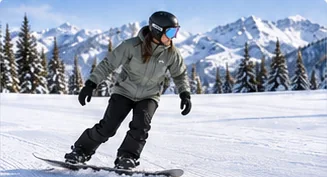
How to snowboard moguls
Ride bumps with control by picking a line and absorbing terrain.
Next-level skills
Build up gradually
To snowboard on steep slopes, step up one small increment at a time and control your speed inside every turn: finish each turn across the hill, commit your weight forward as the board points downhill, and sideslip wherever there is no room to turn.
Part of Carving and all-mountain riding
At a glance
Before this guide
The best judge of whether you are ready is someone who has watched you ride.
Learning how to snowboard on steep slopes is a gradual process. Reading a guide does not make you ready for a black diamond; being able to ride the terrain below it consistently well does.
Signs that you may be ready to try something a little steeper include:
Clean edge control from our carving progression is a strong foundation, but steeps also test commitment and speed control. A lesson with a qualified instructor is the most reliable way to check. They can spot habits such as leaning into the hill or rushing the toeside turn, and choose a suitable next run. Instructors trained through PSIA-AASI in the US, or the equivalent national association elsewhere, are a good place to start; see finding the right lesson.
Step up one small increment at a time, on runs you can see and know.
Trail ratings are relative to each resort. A black diamond at one mountain may be steeper or gentler than a similarly rated run elsewhere, and conditions change the difficulty from day to day. Use ratings as a guide, then judge the run itself.
| Step | What to look for | Move on when… |
|---|---|---|
| Solid blue runs | Wide, groomed intermediate runs you can ride top to bottom | You link turns and stop on demand without thinking about it |
| Short steeper pitch | A brief, wide, groomed steep section with a gentler run-out below | You finish every turn and never feel rushed |
| Groomed black run | A full-length steeper run, groomed, in good visibility | Your turns look the same as on blues, and an instructor agrees |
| Ungroomed or narrow steeps, bowls | Variable snow, bumps, narrow sections, open faces | You handle firm snow, bumps and soft snow separately first |
Double black diamonds are expert terrain. They are not the next step after your first black run; treat them as a long-term goal to work toward with coaching.
On steep terrain, your turn shape is your brake.
On a steep slope, gravity accelerates you faster between turns. The key is to control speed within each turn rather than trying to brake after you have already gone too fast.
Bring the board across the fall line at the end of each turn, and slightly uphill if you need to, before starting the next. A complete, round turn controls speed. A half-finished turn that points you downhill lets speed build.
The moment the board points down the fall line feels most intimidating on steeps. Hesitating or leaning back into the hill makes it longer and more awkward. Move your weight forward over the board and guide it through that point with steady movements. An instructor can help you practice this on easier terrain first.
Keep your stance flexed and your weight centered. Practice new movements on easier terrain before bringing them to steeps.
Steeper runs often have more ice, bumps and chopped-up snow.
Many steeper runs are groomed less often, get scraped by traffic, or develop bumps over the day. Expect a mix of surfaces on the same run.
Stepping back to easier terrain is a smart riding decision. Choose an easier run, or take the easier route down if you have one, when:
If you find yourself on a run that is too steep, stay calm. Move to the side, sideslip or make slow traverses down in control, and look uphill before moving off. Then spend more time on the terrain below until it feels easy.
Practice goals
Checking a box records your practice. Ask your instructor when you are ready to progress.
Common questions
Control speed within each turn by finishing it across the hill before starting the next. Keep your weight centered and flexed, commit to each new turn, and use a controlled sideslip where there is no room to turn.
When you can link controlled turns and stop on both edges consistently on blue runs, and a qualified instructor agrees you are ready. Trail ratings vary between resorts, so look at each run before committing.
Move your weight forward over the board as you start the turn instead of leaning back into the hill, guide the board steadily through the fall line, and finish the turn across the slope to control speed.
Move to the side of the run, stay calm, and sideslip or traverse down slowly on your heel or toe edge. Look uphill before moving off, and spend more time on easier terrain afterward.
Use shorter turns, keep your speed low, and sideslip sections where there is not enough room to turn. Stay aware of others and stop only where you are visible from above.
Up next
Ride bumps with control by picking a line and absorbing terrain.
Stay in control on hard-packed and icy snow with better edge use.
Find a good place to learn nearby and compare lessons before booking.